module mod_pfss.t – potential field source surface model PURPOSE : to extrapolate global potential magnetic field of the sun from synoptic magnetograms 2013.11.04 Developed by S. Moschou and C. Xia 2014.04.01 Allow to change source surface (C. Xia) PRECONDITIONS: More...
Functions/Subroutines | |
| subroutine, public | harm_coef (mapname) |
| subroutine, public | pfss (ixil, ixol, bpf, x) |
Variables | |
| double precision, public | r_s =2.5d0 |
| double precision, public | r_0 =1.d0 |
| integer, public | lmax =0 |
| logical, public | trunc =.false. |
| character(len=20), public | pfss_theta_quadrature ='cell_area' |
Detailed Description
module mod_pfss.t – potential field source surface model PURPOSE : to extrapolate global potential magnetic field of the sun from synoptic magnetograms 2013.11.04 Developed by S. Moschou and C. Xia 2014.04.01 Allow to change source surface (C. Xia) PRECONDITIONS:
- 3D spherical coordinates
- A synoptic magnetogram in a binary file contains nphi, ntheta, theta(ntheta), phi(nphi), B_r(nphi,ntheta) succesively.
- nphi, ntheta are long integers and other arrays are double precision. theta contains decreasing radians with increasing indice (Pi to 0) phi contains increasing radians with increasing indice (0 to 2*Pi)
By default, theta points are interpreted as cell centers and harmonic coefficients use cell-area quadrature in mu=cos(theta). To reproduce the old Gauss-Legendre quadrature, set pfss_theta_quadrature='gauss_legendre' before calling harm_coef. If a mapname.coef file already exists, it is reused and this setting does not take effect until that coefficient file is regenerated. USAGE: example for a magnetogram with name 'mdicr2020.dat':
subroutine initglobaldata_usr ... R_0=1.d0 ! dimensionless Solar radius (default 1.0) R_s=2.5d0 ! dimensionless radius of source surface (default 2.5) lmax=120 ! use a fixed value instead of the value determined by the resolution of input magnetogram trunc=.true. ! use less spherical harmonics at larger distances call harm_coef('mdicr2020.dat') end subroutine initglobaldata_usr
subroutine initonegrid_usr(ixI^L,ixO^L,w,x) ... double precision :: bpf(ixI^S,1:ndir) ... call pfss(ixI^L,ixO^L,bpf,x) w(ix^S,mag(:))=bpf(ix^S,:)
end subroutine initonegrid_usr
Function/Subroutine Documentation
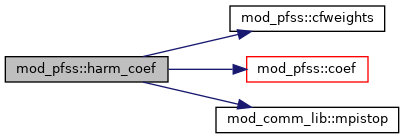
◆ harm_coef()
| subroutine, public mod_pfss::harm_coef | ( | character(len=*) | mapname | ) |
◆ pfss()
| subroutine, public mod_pfss::pfss | ( | integer, intent(in) | ixi, |
| integer, intent(in) | l, | ||
| integer, intent(in) | ixo, | ||
| l, | |||
| double precision, dimension(ixi^s,1:ndir), intent(out) | bpf, | ||
| double precision, dimension(ixi^s,1:ndim), intent(in) | x ) |
Definition at line 329 of file mod_pfss.t.
Variable Documentation
◆ lmax
| integer, public mod_pfss::lmax =0 |
Definition at line 49 of file mod_pfss.t.
◆ pfss_theta_quadrature
| character(len=20), public mod_pfss::pfss_theta_quadrature ='cell_area' |
Definition at line 51 of file mod_pfss.t.
◆ r_0
| double precision, public mod_pfss::r_0 =1.d0 |
Definition at line 47 of file mod_pfss.t.
◆ r_s
| double precision, public mod_pfss::r_s =2.5d0 |
Definition at line 47 of file mod_pfss.t.
◆ trunc
| logical, public mod_pfss::trunc =.false. |
Definition at line 50 of file mod_pfss.t.
Generated by
 1.15.0